

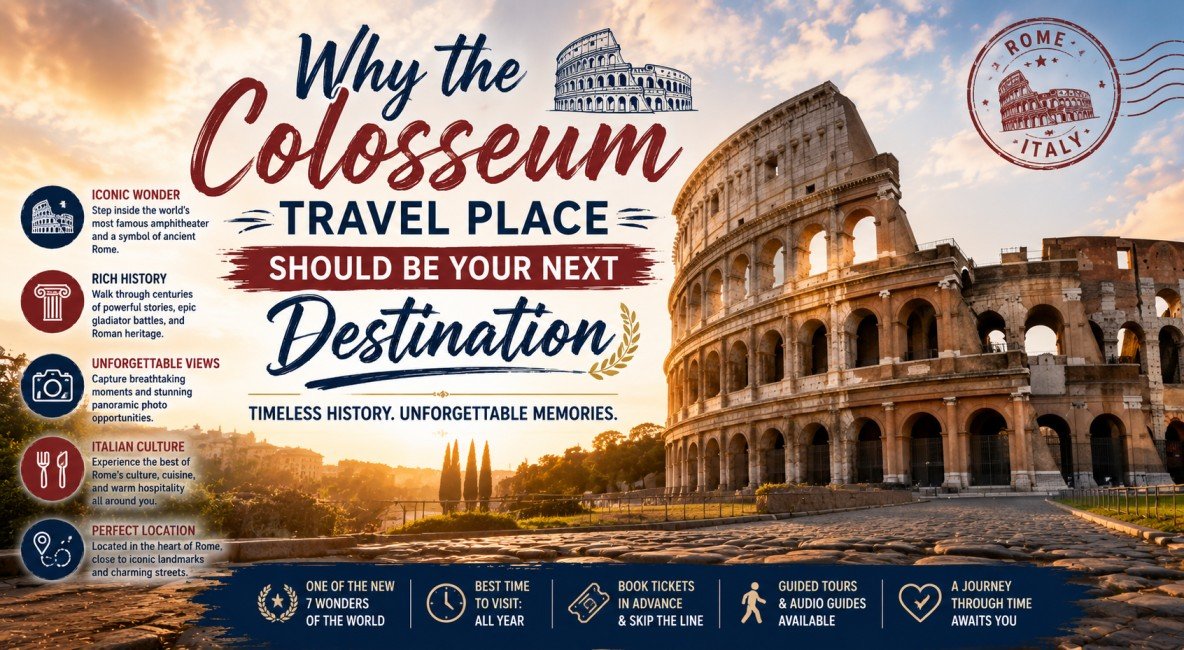
Imagine standing where gladiators once fought for their lives, where roaring crowds of 50,000 spectators once filled the air with thunderous applause. The Colosseum travel place isn’t just a historical site it’s a portal to ancient Rome’s grandeur, power, and spectacle. As the largest amphitheater ever built, the Colosseum stands as a symbol of engineering brilliance and imperial ambition. Whether you’re a history buff, architecture enthusiast, or simply seeking an unforgettable travel experience, visiting the Colosseum is a must. This iconic landmark offers more than just ruins; it delivers an immersive journey into one of the most fascinating civilizations in human history.
Located in the heart of Rome, Italy, the Colosseum also known as the Flavian Amphitheatre is a UNESCO World Heritage Site and one of the New Seven Wonders of the World. Every year, millions of travelers from across the globe flock to this ancient marvel to witness its towering arches, intricate underground chambers, and panoramic views of the Roman Forum. But beyond its visual splendor, the Colosseum holds stories of triumph, tragedy, and transformation that continue to captivate modern audiences.
Planning a trip to the Colosseum? You’re not alone. With over 7 million annual visitors, it’s one of the most visited tourist attractions in the world. Yet, many travelers leave without fully understanding its significance, layout, or hidden gems. This guide dives deep into everything you need to know about the Colosseum travel place from its historical origins and architectural wonders to practical tips for your visit. Whether you’re booking a guided tour, exploring solo, or combining your trip with nearby landmarks, this article ensures you get the most out of your experience.
Historical Significance of the Colosseum Travel Place
The Colosseum was commissioned by Emperor Vespasian of the Flavian dynasty in AD 72 and completed by his son Titus in AD 80. Built on the site of Nero’s extravagant Domus Aurea (Golden House), the amphitheater was a deliberate political move returning land to the people and symbolizing a new era of Roman prosperity. Its construction used over 100,000 cubic meters of travertine stone, held together without mortar, showcasing advanced Roman engineering.
For nearly 500 years, the Colosseum hosted gladiatorial contests, animal hunts, mock naval battles, and public spectacles. These events were not merely entertainment they were tools of social control, reinforcing imperial authority and Roman values. The amphitheater could hold between 50,000 and 80,000 spectators, with a complex system of entrances, exits, and seating that reflected the rigid class structure of Roman society.
Over time, the Colosseum witnessed the fall of the Roman Empire, earthquakes, and looting. Yet, it endured. In the Middle Ages, it was repurposed as a fortress, housing, and even a Christian shrine. Today, it stands as a powerful reminder of Rome’s rise and fall, and a testament to human resilience and creativity.
Key Events That Shaped the Colosseum
- AD 80: Inauguration by Emperor Titus with 100 days of games, including gladiator battles and animal executions.
- AD 217: A fire caused by lightning damaged the upper levels, leading to major repairs.
- 523 AD: The last recorded gladiatorial games took place, marking the end of an era.
- 1749: Pope Benedict XIV consecrated the site as a Christian shrine, honoring martyrs believed to have died there.
- 1980: Designated a UNESCO World Heritage Site, recognizing its global cultural importance.
Architectural Marvels of the Colosseum Travel Place
The Colosseum is a masterpiece of Roman engineering. Its elliptical structure measures 189 meters long, 156 meters wide, and 50 meters high equivalent to a 15-story building. The exterior features four levels of arches, each adorned with different architectural orders: Tuscan, Ionic, Corinthian, and Composite. This design not only added aesthetic beauty but also distributed weight efficiently, allowing the structure to withstand centuries of wear.
One of the most impressive aspects of the Colosseum is its hypogeum the underground network of tunnels and chambers beneath the arena floor. This complex system housed elevators, pulleys, and trapdoors used to lift animals, gladiators, and scenery into the arena. The hypogeum was a logistical marvel, enabling dramatic entrances and surprise elements during performances.
The seating arrangement, or cavea, was meticulously planned. The emperor and elite citizens sat in the lowest tier, while women, slaves, and the poor were relegated to the highest levels. A sophisticated system of 80 entrances and vomitoria (passageways) allowed the entire audience to enter and exit within minutes a design still studied by modern stadium architects.
Engineering Innovations That Still Impress
- Velarium: A retractable awning made of canvas and ropes, operated by sailors from the Roman navy, to shield spectators from sun and rain.
- Drainage System: Advanced channels prevented flooding during mock naval battles (naumachiae).
- Modular Construction: Prefabricated stone blocks allowed rapid assembly and future repairs.
- Acoustic Design: The curved seating and open center ensured even those in the back could hear announcements and cheers.
What to See and Do at the Colosseum Travel Place
A visit to the Colosseum travel place is more than just walking around ruins. With the right planning, you can explore multiple layers of history and enjoy a rich, educational experience. Start with the main arena floor, where you can stand in the center and imagine the roar of ancient crowds. Guided tours often include access to restricted areas like the underground chambers and upper tiers, offering a behind-the-scenes look at Roman spectacle.
Don’t miss the Colosseum’s museum, located on the upper levels, which displays artifacts such as gladiator armor, weapons, and inscriptions. Interactive exhibits and 3D reconstructions help bring the past to life. For a unique perspective, consider a night tour some operators offer after-dark visits with dramatic lighting and fewer crowds.
Combine your visit with the Roman Forum and Palatine Hill, which are included in the same ticket. These adjacent sites provide context to the Colosseum’s role in Roman public life. The Forum was the political, religious, and commercial heart of ancient Rome, while the Palatine Hill was home to emperors and aristocrats.
Top Experiences at the Colosseum
- Guided Historical Tours: Led by licensed archaeologists or historians, these tours offer in-depth insights into gladiator life, Roman politics, and engineering.
- Skip-the-Line Access: Essential during peak season (April–October), as wait times can exceed two hours.
- Virtual Reality Experiences: Some tours use VR headsets to reconstruct the Colosseum in its full glory.
- Photography Spots: The Arch of Constantine, the outer perimeter at sunset, and the view from Palatine Hill offer stunning photo opportunities.
- Evening Light Shows: Seasonal projections and soundscapes transform the Colosseum into a cinematic experience.
Best Time to Visit the Colosseum Travel Place
Timing your visit can make a significant difference in your experience. The Colosseum is open year-round, but crowd levels and weather vary greatly. The peak tourist season runs from April to October, with July and August being the busiest and hottest months. If you prefer fewer crowds and milder weather, consider visiting in late autumn (November) or early spring (March).
Winter visits (December–February) offer the lowest prices and smallest crowds, though some areas may be closed due to weather. Early mornings (right at opening) and late afternoons (before closing) are ideal for avoiding midday heat and tour groups. Weekdays are generally less crowded than weekends.
Special events, such as the annual “Colosseum at Night” or cultural festivals, may affect access. Check the official website for updates on closures, maintenance, and exclusive tours.
Seasonal Guide to Visiting
- Spring (March–May): Pleasant weather, blooming gardens, and moderate crowds. Ideal for photography and walking tours.
- Summer (June–August): Hot and crowded, but longest opening hours. Book skip-the-line tickets in advance.
- Autumn (September–November): Cooler temperatures, fewer tourists, and beautiful golden light. Great for in-depth exploration.
- Winter (December–February): Quietest time to visit, with potential for rain. Some upper levels may be closed.
How to Get to the Colosseum Travel Place
The Colosseum is centrally located in Rome, making it easily accessible by public transport, taxi, or on foot. The nearest metro station is Colosseo on Line B (Blue Line), just a 2-minute walk from the entrance. Buses 75, 81, 673, and 175 also stop nearby.
If you’re staying in the historic center, walking is a scenic and convenient option. From the Roman Forum, it’s a 5-minute stroll. From the Trevi Fountain or Piazza Venezia, allow 15–20 minutes. Taxis and ride-sharing apps like Free Now are widely available, but traffic can be heavy during peak hours.
For international travelers, Rome has two major airports: Fiumicino (Leonardo da Vinci) and Ciampino. Both offer direct train and bus connections to the city center. From Fiumicino, take the Leonardo Express train to Termini Station, then transfer to Metro Line B.
Transportation Tips
- Use the Roma Pass for discounted public transport and free entry to one or two museums.
- Avoid driving parking is limited and traffic restrictions apply in the historic center.
- Wear comfortable shoes there’s a lot of walking on uneven surfaces.
- Download offline maps or use Google Maps for real-time navigation.
Ticket Options and Pricing for the Colosseum Travel Place
Admission to the Colosseum requires a ticket, which also includes access to the Roman Forum and Palatine Hill. Prices vary based on age, residency, and type of experience. As of 2024, standard tickets cost €18 for adults, with discounts for EU citizens aged 18–25 and free entry for children under 18.
For a richer experience, consider upgrading to a guided tour or special access ticket. These often include entry to the underground (hypogeum), upper tiers, or arena floor areas not accessible with a standard ticket. Prices for premium tours range from €35 to €70, depending on duration and inclusions.
Booking online in advance is highly recommended, especially during peak season. The official website (coopculture.it) offers real-time availability and secure payment. Beware of third-party resellers that may charge inflated prices or sell fake tickets.
Ticket Comparison
- Standard Ticket (€18): Access to Colosseum, Roman Forum, and Palatine Hill. Valid for 2 days.
- Full Experience Ticket (€24): Includes standard access plus the arena floor and underground.
- Guided Group Tour (€45–€60): 90-minute tour with expert guide, skip-the-line access, and small group size.
- Private Tour (€150+): Customizable itinerary, personal guide, and flexible timing.
- Roma Pass (€33–€53): Includes public transport and free/discounted entry to multiple sites.
Cultural and Symbolic Importance of the Colosseum Travel Place
Beyond its physical presence, the Colosseum holds deep cultural and symbolic meaning. It represents the height of Roman imperial power, the brutality of ancient entertainment, and the resilience of human heritage. Today, it serves as a global icon of peace and remembrance. Since 2000, the Colosseum has been illuminated in gold whenever a person is freed from slavery, as part of the “Freedom Lights Up the Colosseum” campaign by the anti-slavery organization Walk Free.
The site also plays a role in modern media and education. It has been featured in countless films, documentaries, and video games, from Gladiator to Assassin’s Creed. Schools and universities worldwide use the Colosseum to teach about ancient history, architecture, and ethics.
For Italians, the Colosseum is a source of national pride and identity. It appears on coins, stamps, and government logos, symbolizing Italy’s rich cultural legacy. Annual events, such as historical reenactments and academic conferences, keep its story alive for new generations.
Preservation Efforts and Challenges
The Colosseum faces ongoing threats from pollution, tourism pressure, and natural decay. In recent years, major restoration projects have been undertaken to stabilize the structure, clean the façade, and improve visitor facilities. A €25 million restoration completed in 2016 focused on the outer wall and underground areas.
Future plans include installing a new retractable floor to recreate the original arena surface, allowing visitors to walk where gladiators once fought. Environmental controls, such as air filtration systems, are also being considered to protect the stone from smog and acid rain.
Despite these efforts, balancing preservation with public access remains a challenge. Authorities limit daily visitor numbers and enforce strict rules no touching the walls, no flash photography, and no littering. Visitors are encouraged to be respectful and mindful of their impact.
Key Takeaways
- The Colosseum travel place is a must-visit destination for anyone interested in history, architecture, or culture.
- It offers a unique blend of ancient spectacle, engineering brilliance, and modern significance.
- Plan your visit during off-peak hours, book tickets in advance, and consider a guided tour for deeper insights.
- Combine your trip with the Roman Forum and Palatine Hill for a complete ancient Rome experience.
- Respect the site’s preservation rules to help protect this global treasure for future generations.
FAQ
How long does it take to visit the Colosseum?
A typical visit lasts 1.5 to 3 hours, depending on your interest level and whether you explore the Roman Forum and Palatine Hill. Guided tours usually run 90 minutes, while self-guided visits allow more flexibility.
Can I visit the Colosseum at night?
Yes, special night tours are available seasonally, offering a unique atmosphere with dramatic lighting and fewer crowds. These tours often include access to restricted areas and are highly recommended for a memorable experience.
Are there wheelchair-accessible routes at the Colosseum?
Yes, the Colosseum has made significant improvements for accessibility. There are ramps, elevators, and designated paths for visitors with reduced mobility. However, some areas, like the upper tiers and underground, may still be challenging. Contact the site in advance for specific accommodations.

